Case Studies/Codes
Example Modelling Example Codes
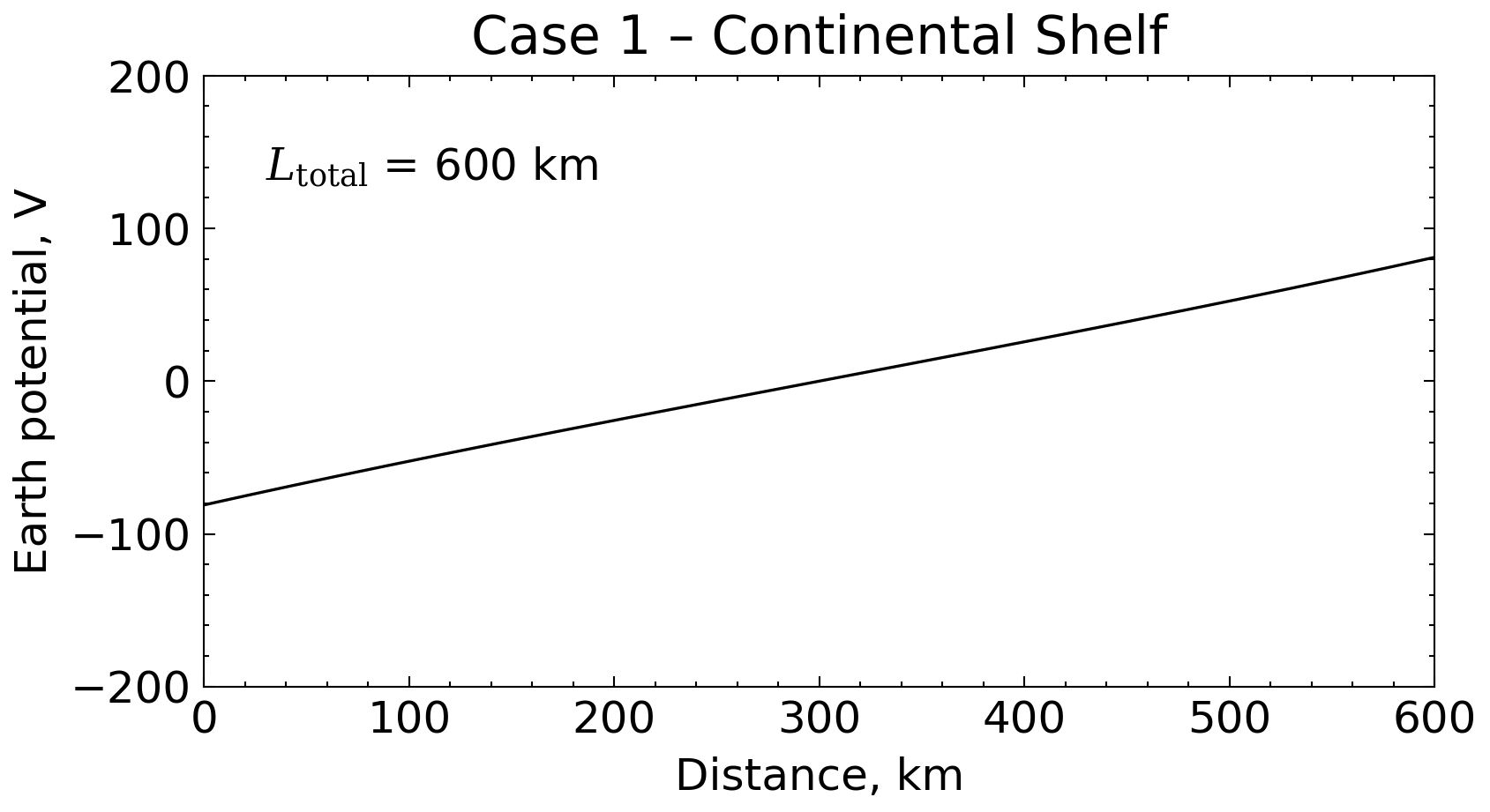
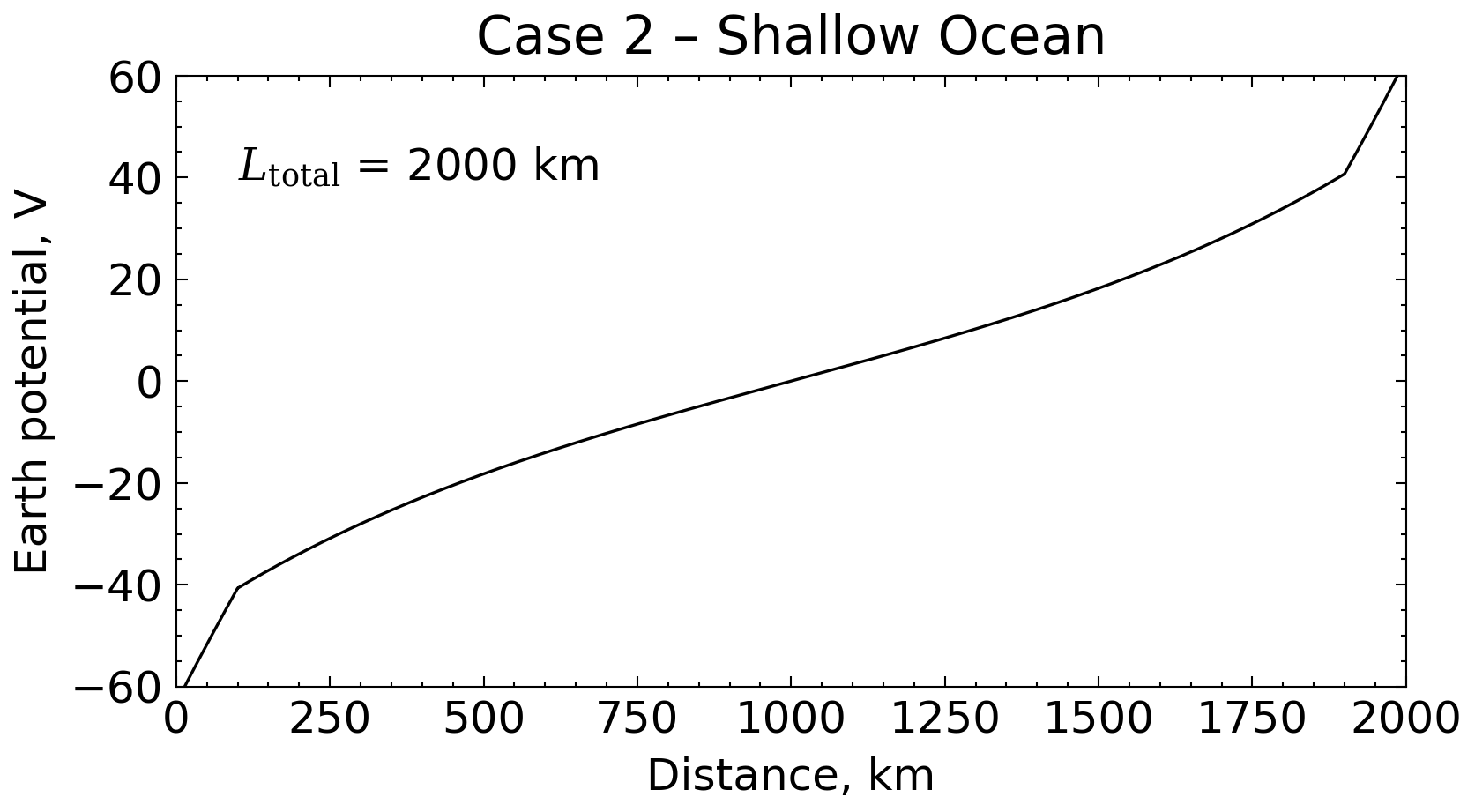
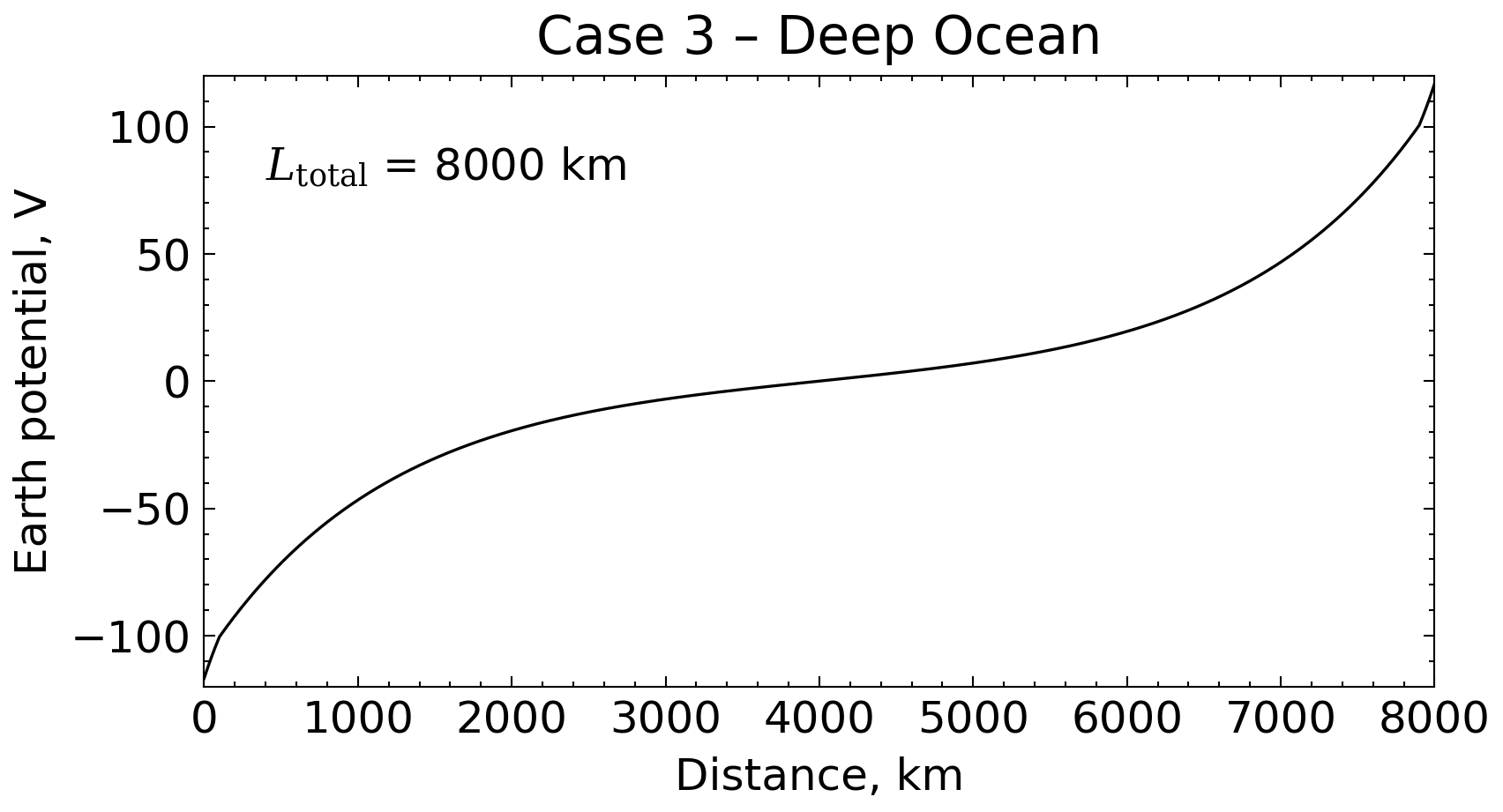
To illustrate the application of the modelling technique and to examine the voltages produced in typical Ocean/Earth conductivity structures we present results for three models representing 1) a shallow sea/continental shelf, 2) a shallow ocean, and 3) a deep ocean.
- Shallow Sea/Continental Shelf
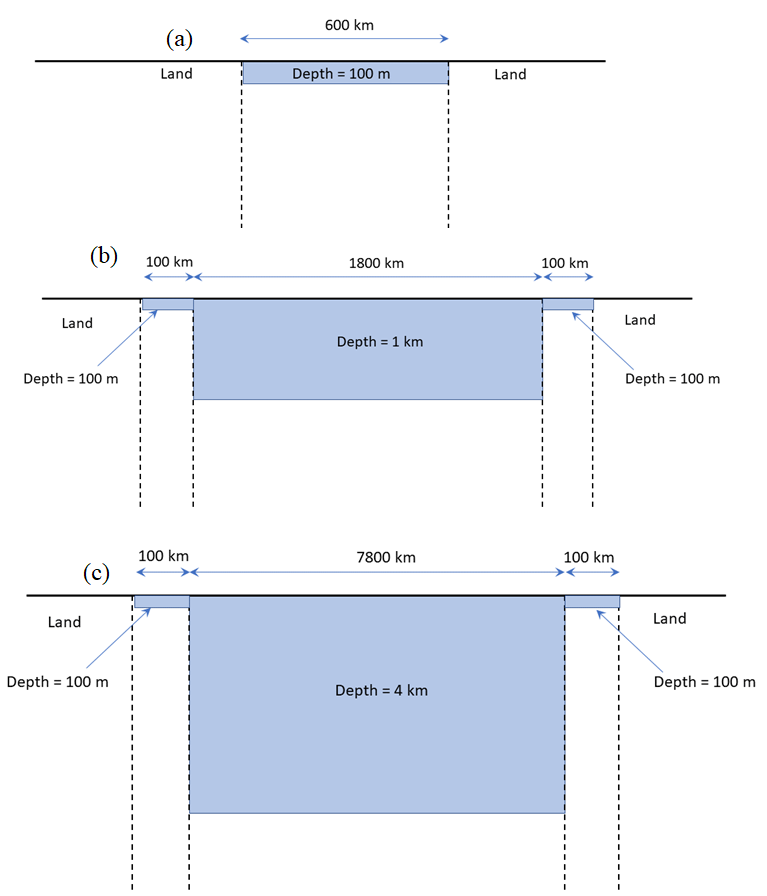
This model consists of a shallow sea 600 km wide, with a depth of 100 m, with land at either end as shown in figure (a). The seawater section has the same properties as the continental shelf in table listed in network modeling. This is a simplified model approximation to the North Sea.
- Shallow Ocean
This model consists of a deep ocean section 1800 km wide, with a depth of 1 km, with continental shelf 100 km wide and 100 m deep on either side as shown in figure (b). The total width from coast to coast is 2000 km. The parameters for each section are the same as those shown in table listed in network modeling, except the ocean section has a seawater depth of 1 km. This is a simplified model approximation of the Tasman Sea.
- Deep Ocean
This model consists of a deep ocean section 7800 km wide, with a depth of 4 km, with continental shelf 100 km wide and 100 m deep on either side as shown in Figure (c). The total width from coast to coast is 8000 km. The parameters for each section are as shown in table listed in network modeling. This is a simplified model approximation of the Pacific Ocean.
Transmission Line Parameters
For each model the layer thicknesses and resistivities from table in network modeling are used to calculate the transmission line series impedance, \(Z\), and parallel admittance, \(Y\). These values are then used to calculate the transmission line propagation constant, \(\gamma\), characteristic impedance, \(Z_0\), and adjustment distance, \(\frac{1}{\gamma}\) for each section. The values obtained are shown in table below. The 'Shallow Sea' parameters are used for the continental shelf sections in models 2 and 3 as well as for the seawater section in model 1.
| Depth (m) | \(Z\) (\(\Omega/km\)) | \(Y\) (S/km) | \(\gamma\) (\(km^{-1}\)) | \(Z_0\) (\(\Omega\)) | Adj. Distance (km) | |
|---|---|---|---|---|---|---|
| Continental Shelf | 100 | \(7.5\times 10^{-1}\) | \(5\times 10^{-6}\) | \(1.9365\times 10^{-3}\) | \(3.873\times 10^{2}\) | 516.4 |
| Shalow Ocean | 1000 | \(2.5\times 10^{-1}\) | \(1.0\times 10^{-5}\) | \(1.58\times 10^{-3}\) | \(1.58\times 10^{2}\) | 632.5 |
| Deep Ocean | 4000 | \(7.14\times 10^{-1}\) | \(1.0\times 10^{-5}\) | \(8.45\times 10^{-4}\) | \(8.45\times 10^{1}\) | 1183.2 |
| Land | 0 | 3.0 | \(5.0\times 10^{-6}\) | \(3.873\times 10^{-3}\) | \(7.746\times 10^{2}\) | 258.2 |
Example
from pathlib import Path

import pandas as pd

from scubas.datasets import PROFILES
from scubas.cables import Cable, TransmissionLine
from scubas.plotlib import cable_potential, update_rc_params

figures_dir = Path("docs/tutorial/figures")
figures_dir.mkdir(parents=True, exist_ok=True)

update_rc_params(
    {
        "font.family": "sans-serif",
        "font.sans-serif": ["Tahoma", "DejaVu Sans", "Lucida Grande", "Verdana"],
    },
    science=True,
)

def create_induced_field(millivolts_per_km: float) -> pd.DataFrame:
    return pd.DataFrame({"X": [millivolts_per_km]}, index=pd.RangeIndex(1, name="Time"))

def build_transmission_line(
    sec_id: str,
    length_km: float,
    profile,
    efield: pd.DataFrame,
    terminations=None,
) -> TransmissionLine:
    tl = TransmissionLine(
        sec_id=sec_id,
        directed_length={"length_north": length_km},
        elec_params={"site": profile, "width": 1.0, "flim": [1e-6, 1.0]},
        active_termination=terminations,
    )
    tl.compute_eqv_pi_circuit(Efield=efield, components=["X"])
    return tl

def simulate_case(title: str, slug: str, sections, ylim):
    tlines = [build_transmission_line(**section) for section in sections]
    cable = Cable(tlines, components=["X"])
    potentials, distances = cable._pot_along_cable_(timestamp=0)

    plot = cable_potential(potentials, distances, ylim=ylim)
    plot.axes.set_title(title)
    plot.axes.text(
        0.05,
        0.85,
        rf"$L_{\mathrm{total}}$ = {sum(section['length_km'] for section in sections):.0f} km",
        ha="left",
        va="center",
        transform=plot.axes.transAxes,
    )
    plot.figure.savefig(
        figures_dir / f"{slug}.png",
        dpi=300,
        bbox_inches="tight",
    )
    plot.figure.clf()

efield_cs = create_induced_field(300.0)
efield_ocean = create_induced_field(100.0)

simulate_case(
    title="Case 1 – Continental Shelf",
    slug="conduct_case1_continental_shelf",
    sections=[
        {"sec_id": "CS", "length_km": 600.0, "profile": PROFILES.CS, "efield": efield_cs},
    ],
    ylim=(-200.0, 200.0),
)

simulate_case(
    title="Case 2 – Shallow Ocean",
    slug="conduct_case2_shallow_ocean",
    sections=[
        {
            "sec_id": "CS-west",
            "length_km": 100.0,
            "profile": PROFILES.CS,
            "efield": efield_cs,
            "terminations": {"left": {"site": PROFILES.LD, "width": 1.0}},
        },
        {
            "sec_id": "SO",
            "length_km": 1800.0,
            "profile": PROFILES.SO,
            "efield": efield_ocean,
        },
        {
            "sec_id": "CS-east",
            "length_km": 100.0,
            "profile": PROFILES.CS,
            "efield": efield_cs,
            "terminations": {"right": {"site": PROFILES.LD, "width": 1.0}},
        },
    ],
    ylim=(-60.0, 60.0),
)

simulate_case(
    title="Case 3 – Deep Ocean",
    slug="conduct_case3_deep_ocean",
    sections=[
        {
            "sec_id": "CS-west",
            "length_km": 100.0,
            "profile": PROFILES.CS,
            "efield": efield_cs,
            "terminations": {"left": {"site": PROFILES.LD, "width": 1.0}},
        },
        {
            "sec_id": "DO",
            "length_km": 7800.0,
            "profile": PROFILES.DO,
            "efield": efield_ocean,
        },
        {
            "sec_id": "CS-east",
            "length_km": 100.0,
            "profile": PROFILES.CS,
            "efield": efield_cs,
            "terminations": {"right": {"site": PROFILES.LD, "width": 1.0}},
        },
    ],
    ylim=(-120.0, 120.0),
)