Long and Short Cables
Electrically Long Cable
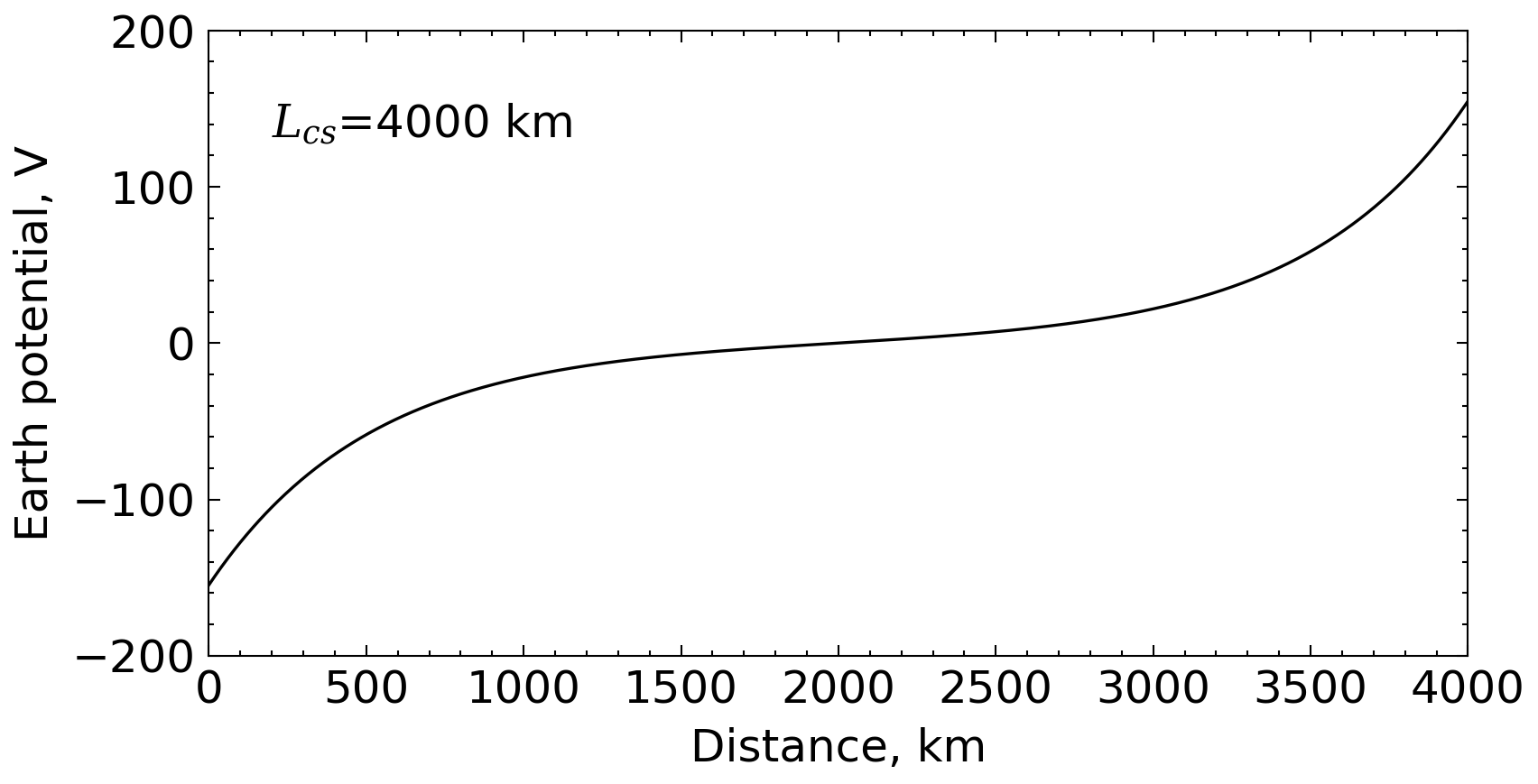
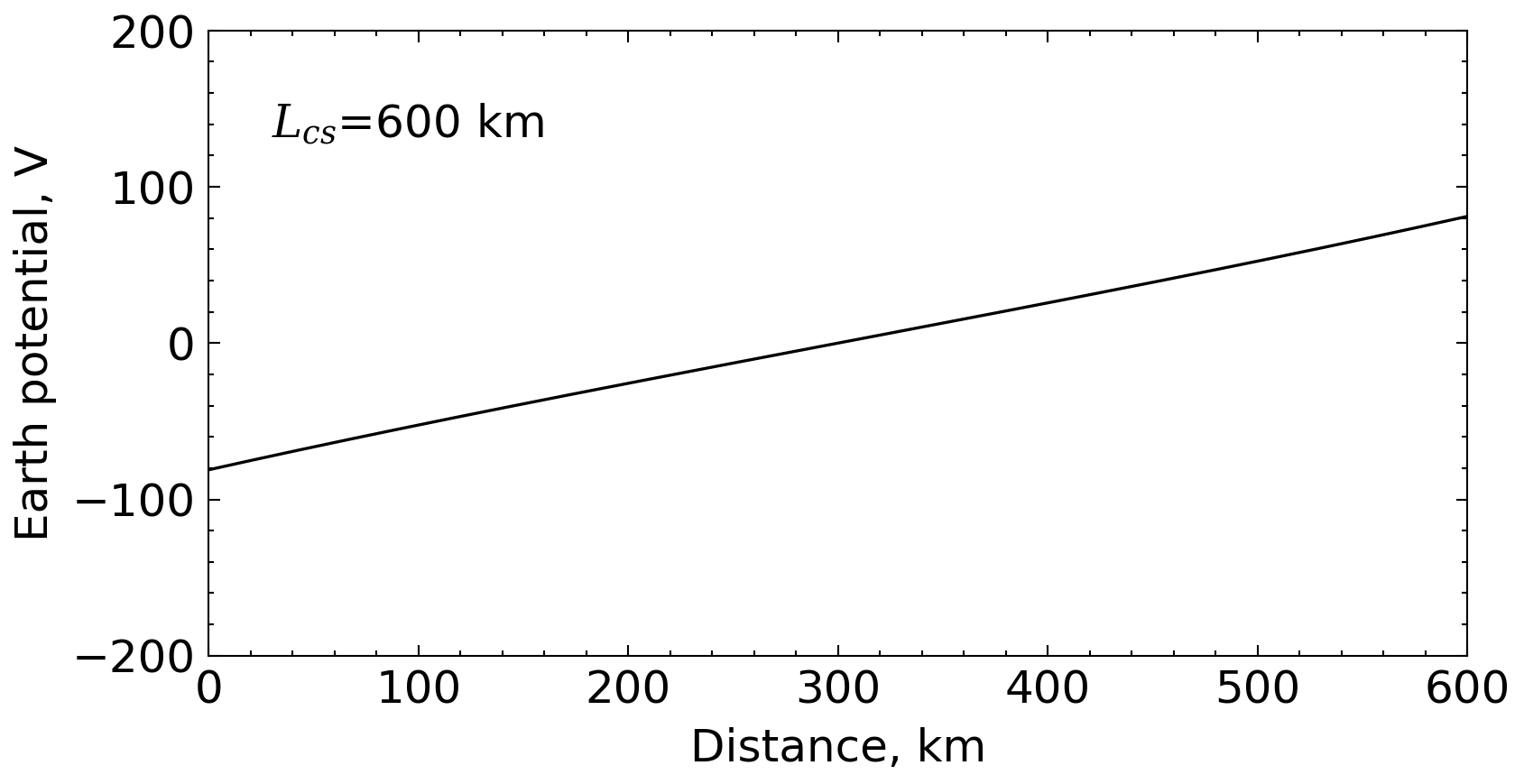
Consider an Ocean-Earth section with physical length, \(L\), and propagation constant, \(\gamma\). The section has an adjustment distance \(\frac{1}{\gamma}\). For an electrically-long transmission line, where \(L>\frac{4}{\gamma}\) (i.e. length is greater than four times of adjustment distance) we have the following scenario,
When the transmission line length is considerably shorter than the adjustment distance it is referred to as 'electrically-long' and the equivalent-\(\pi\) components reduce to (Boteler et a, 2013):
where \(V_i=-V_k=V=\frac{E}{\gamma}\).
Example
from pathlib import Path

import pandas as pd

from scubas.datasets import PROFILES
from scubas.models import OceanModel
from scubas.plotlib import cable_potential, plot_transfer_function, update_rc_params
from scubas.cables import Cable, TransmissionLine

figures_dir = Path("docs/tutorial/figures")
figures_dir.mkdir(parents=True, exist_ok=True)

update_rc_params(
    {
        "font.family": "sans-serif",
        "font.sans-serif": ["Tahoma", "DejaVu Sans", "Lucida Grande", "Verdana"],
    },
    science=True,
)

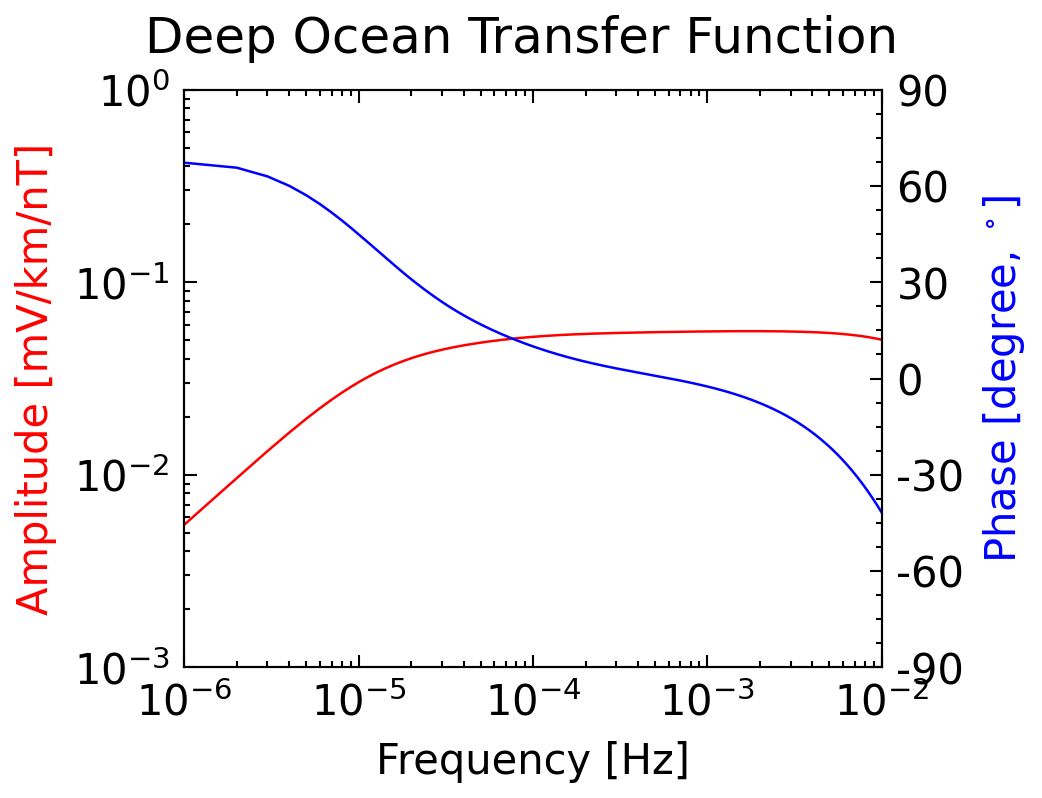
ocean_model = OceanModel(PROFILES.DO_3)
transfer_function = ocean_model.get_TFs()
tf_artifacts = plot_transfer_function(transfer_function)
tf_artifacts.figure.suptitle("Deep Ocean Transfer Function")
tf_artifacts.figure.savefig(
    figures_dir / "electrically_cable_transfer_function.png",
    dpi=300,
    bbox_inches="tight",
)

####################################################################
# Simulating the case: Induced electric field 0.3 V/km on a
# shallow continental shelf with depth 100 m, length 600 km
####################################################################
induced_e_field = pd.DataFrame(
    {"X": [300.0]},
    index=pd.RangeIndex(1, name="Time"),
)

length = 600.0
transmission_line = TransmissionLine(
    sec_id="CS-long",
    directed_length={"length_north": length},
    elec_params={"site": PROFILES.CS, "width": 1.0, "flim": [1e-6, 1.0]},
)
transmission_line.compute_eqv_pi_circuit(
    Efield=induced_e_field,
    components=["X"],
)

cable = Cable([transmission_line], components=["X"])
potentials, distances = cable._pot_along_cable_(timestamp=0)
potential_plot = cable_potential(potentials, distances, ylim=(-200, 200))
potential_plot.axes.text(
    0.05,
    0.85,
    rf"$L_{{cs}}$={length:.0f} km",
    ha="left",
    va="center",
    transform=potential_plot.axes.transAxes,
)
potential_plot.figure.savefig(
    figures_dir / "electrically_long_cable_potential.png",
    dpi=300,
    bbox_inches="tight",
)
Electrically Short Cable
For an electrically-short section, where the physical length is less than the adjustment distance, i.e., \(L<\frac{1}{\gamma}\). When the transmission line length is considerably shorter than the adjustment distance it is referred to as 'electrically-short' and the equivalent-\(\pi\) components reduce to (Boteler et a, 2013):
Example
####################################################################
# Simulating the case: Induced electric field 0.3 V/km on a
# shallow continental shelf with depth 100 m, length 4000 km
####################################################################
from pathlib import Path

import pandas as pd

from scubas.cables import Cable, TransmissionLine
from scubas.datasets import PROFILES
from scubas.models import OceanModel
from scubas.plotlib import (
    cable_potential,
    plot_transfer_function,
    update_rc_params,
)

figures_dir = Path("docs/tutorial/figures")
figures_dir.mkdir(parents=True, exist_ok=True)

update_rc_params(
    {
        "font.family": "sans-serif",
        "font.sans-serif": ["Tahoma", "DejaVu Sans", "Lucida Grande", "Verdana"],
    },
    science=True,
)

ocean_model = OceanModel(PROFILES.DO_3)
transfer_function = ocean_model.get_TFs()
tf_artifacts = plot_transfer_function(transfer_function)
tf_artifacts.figure.suptitle("Deep Ocean Transfer Function")
tf_artifacts.figure.savefig(
    figures_dir / "electrically_cable_transfer_function.png",
    dpi=300,
    bbox_inches="tight",
)

induced_e_field = pd.DataFrame(
    {"X": [300.0]},
    index=pd.RangeIndex(1, name="Time"),
)

length = 4000.0
transmission_line = TransmissionLine(
    sec_id="CS-short",
    directed_length={"length_north": length},
    elec_params={"site": PROFILES.CS, "width": 1.0, "flim": [1e-6, 1.0]},
)
transmission_line.compute_eqv_pi_circuit(
    Efield=induced_e_field,
    components=["X"],
)

cable = Cable([transmission_line], components=["X"])
potentials, distances = cable._pot_along_cable_(timestamp=0)
potential_plot = cable_potential(potentials, distances, ylim=[-200, 200])
potential_plot.axes.text(
    0.05,
    0.85,
    rf"$L_{{cs}}$={length:.0f} km",
    ha="left",
    va="center",
    transform=potential_plot.axes.transAxes,
)
potential_plot.figure.savefig(
    figures_dir / "electrically_short_cable_potential.png",
    dpi=300,
    bbox_inches="tight",
)